
Wind and hail damage, documented properly.
Storm repair for Treasure Coast homes and businesses — inspected, photographed and repaired by a licensed Florida contractor.
Storm season reality: the second rain does the damage.
The first storm opens the roof. The second one finds the opening and gets into insulation, drywall and framing. That gap is where a repair becomes a rebuild.
- Stay off the roof. Assess from the ground and from inside the attic.
- Photograph everything — wide shots and close-ups — before any cleanup.
- Call for emergency tarping to stop water getting further in.
- Verify any contractor's Florida licence before you sign anything.
Damage you can see, and damage you can’t
Missing shingles are obvious. Lifted fasteners, bruised mats and cracked tile underlayment are not — and those are what fail six months later.
Full storm inspection
Surface, flashings, edge metal, vents and decking checked for wind uplift and impact damage.
Photo documentation
Dated, detailed images that support your claim and your repair scope.
Repair or replace
An honest read on whether the roof is repairable or the system is compromised.
Emergency response
Active leaks prioritized. We tarp first and diagnose second.
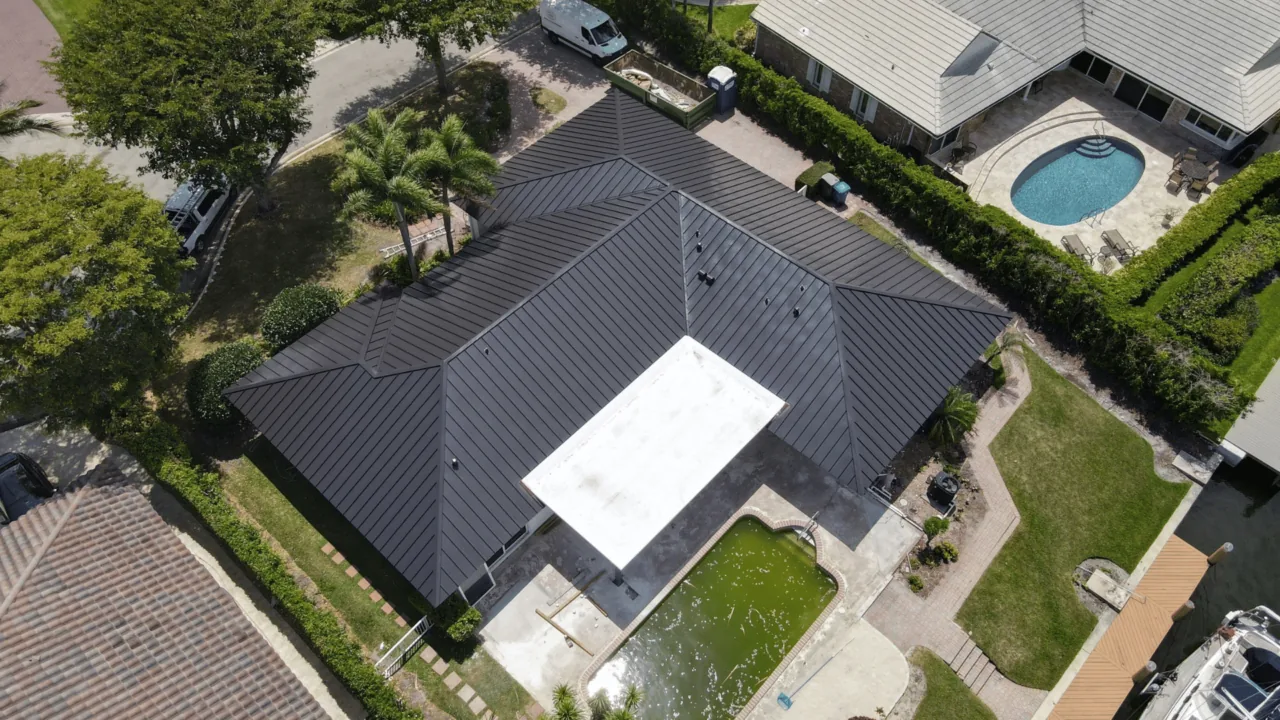
Filing a claim? Documentation is the whole game
Claims get reduced or denied because damage wasn’t documented before cleanup, or because the scope was written too thin.
We inspect, photograph and write the scope the way carriers expect — and we’re available when the adjuster walks the roof.
How we handle storm work
Priority scheduling
Storm and active-leak calls move to the front of the schedule.
Adjuster coordination
We can meet your adjuster on site and walk the damage with them.
No claim pressure
If the damage doesn’t justify a claim, we tell you rather than push one.
Licensed CCC1337211
Florida certified and insured. Verify us before you hire us.
What storm damage actually looks like
Most of it does not look like a hole in your roof. The damage that costs you the most is the damage you cannot see from the ground.
Broken seal strips
The single most consequential and least visible form of wind damage. Shingles are glued down by a heat-activated strip; once a gust breaks that bond the tab flutters in every subsequent wind, works its nails loose, and eventually leaves. From the driveway the roof looks perfect.
Creased and lifted tabs
A shingle that lifted and laid back down carries a crease across its width. That crease is a fracture in the mat and it will open. Adjusters are trained to look for it, which is why documentation matters.
Displaced or cracked tile
Tile shifts under uplift and under impact from debris. Because tile is a rain screen over underlayment, a slipped tile does not leak immediately — it just starts UV-cooking the layer that was doing the actual waterproofing.
Hail bruising
Less common here than in the Midwest but real, particularly in spring line storms. It shows as soft dark circles where granules were knocked off and the mat is bruised. It shortens roof life without leaking for years.
Flashing and edge metal damage
Drip edge peeled, ridge cap gone, vent hoods bent or torn off. Uplift starts at edges and corners, which is exactly why the code specifies tighter fastener spacing there.
Impact damage
Branches, fence panels, neighbours’ roof material and anything else the storm carried. Punctures are obvious; the bruising along the path of a rolling branch is not.
What to do in the first 48 hours
In this order. The sequence genuinely matters for your claim.
1. Stop the water
If it is coming in, mitigating further damage is both sensible and your responsibility under the policy. Tarping counts as mitigation. Call us on 772-589-2400 and we will get a proper battened tarp on it. See emergency roof tarping.
2. Photograph everything before you touch it
Interior and exterior, wide and close. Ceiling stains, wet insulation, damaged contents, debris on the ground. Date-stamped photographs taken before cleanup are the most useful evidence you will ever have, and almost nobody takes enough of them.
3. Do not get on the roof yourself
Wet, wind-damaged roofs with compromised decking are how people get seriously hurt. It also is not necessary — a free inspection gets you the same information without the risk.
4. Call your carrier and open the claim
Under Florida Statute 627.70132 you have one year from the date of loss to file an initial claim and 18 months for a supplemental. Those clocks run from the storm date, not from when you noticed the damage. Do not sit on it. See our Florida roof insurance claim guide for the full filing process.
5. Get an independent roofing assessment
Before the adjuster arrives, ideally. Knowing what is actually wrong with your roof puts you in a far better position than finding out from someone whose employer pays the claim. Ours is free and we will meet the adjuster on site with you.
6. Be extremely careful who you sign with
Storm chasers arrive within days. Do not sign anything on your driveway, do not hand over an assignment of benefits to someone you met yesterday, and verify the licence number. See hurricane roofing scams.
How we work a storm claim with you
We are the roofing contractor, not your public adjuster — but documentation done properly is most of the battle.
A documented inspection
Dated photographs of every damaged element, measurements, slope diagrams and a written scope in the format carriers expect. Vague scopes get underpaid.
We meet your adjuster
On the roof, with our documentation, so the assessment happens with someone present who knows what they are looking at and can point to it.
A code-compliant scope
Your repair has to meet current Florida Building Code, and code upgrade costs are frequently a legitimate part of the claim. A scope that ignores the 160 mph wind zone and the secondary water barrier requirement is a scope that leaves your money on the table.
The 25% question, answered honestly
If more than 25% of a roof section is damaged, the code may require the whole section brought current — but the 2007 exception often means it does not. We measure and tell you which applies. See the 25% rule.
Supplementals when they are warranted
Damage found at tear-off that nobody could have seen from the surface is a normal, legitimate supplemental. We document it the day we find it so it is not a fight later.
Permitted, inspected, warranted
The permanent repair is pulled, inspected and closed out properly, with your warranty paperwork and the full photo set handed over at the end.
What your policy does and does not cover
Read this before you file, not after.
Covered: sudden accidental damage
Wind, hail, falling objects, impact. A discrete event on a discrete date. That is what property insurance is for and that is what gets paid.
Not covered: age, wear and deferred maintenance
A 24-year-old roof that finally let go is not a storm claim, regardless of what the weather did that week. Anyone telling you otherwise is proposing you commit fraud and is not worried about which of you carries the consequence.
Roof deductibles are separate and larger
Most Florida policies carry a hurricane or windstorm deductible expressed as a percentage of dwelling coverage — typically 2% or 5% — not the flat all-other-perils figure. On a $500,000 dwelling a 2% hurricane deductible is $10,000 before the carrier pays anything. Check which deductible applies before you assume a claim is worth filing.
ACV versus replacement cost matters enormously
A replacement cost policy pays what it costs to replace the roof today. An actual cash value policy pays that minus depreciation for age — which on a 17-year-old roof can be most of the value. Many Florida carriers have moved older roofs to ACV or to a roof surfacing payment schedule. Your declarations page says which you have.
Matching, and why partial repairs get complicated
If your shingle is discontinued and a repair would leave a visibly mismatched section, that can support a larger scope. It is fact-specific and it is worth documenting the discontinuation in writing at the time.
We are not your adjuster, and we will say so
We document the roof accurately and professionally. We do not negotiate your claim, we do not take an assignment of benefits, and we do not promise you an outcome we do not control. If your claim is complex, a licensed public adjuster is a legitimate option worth considering.
Storm damage FAQs
How quickly can you get here after a storm?
Active leaks get priority and we can usually tarp within 24 to 48 hours. After a major named storm the whole region calls at once, so be realistic — but call early, because the queue is first-come.
How long do I have to file a claim in Florida?
One year from the date of loss for an initial claim, and 18 months for a supplemental, under Florida Statute 627.70132. Both clocks start on the storm date, not on the date you discovered the damage.
Should I file a claim at all?
Only if the damage plausibly exceeds your hurricane or windstorm deductible, which is usually a percentage of your dwelling coverage rather than a flat amount. A free inspection will tell you roughly what the damage is worth so you can make that call with information.
My roof looks fine from the ground. Do I still need it checked?
Yes. Broken seal strips and creased tabs are the most common forms of wind damage and neither is visible from the ground. They leak months later, by which point your filing window may be closing.
Can you meet my insurance adjuster?
Yes, and we recommend it. We will be on the roof with our documentation so the assessment happens with a roofer present rather than after the fact.
Someone knocked on my door offering a free roof. Should I?
Be very careful. Legitimate contractors do not promise to cover your deductible, do not need a signature today, and are licensed in Florida with a verifiable CCC or CGC number. See hurricane roofing scams.
Will my rates go up if I file?
Possibly, and it varies by carrier and claim history. That is a genuine consideration and one reason we tell people honestly when damage is unlikely to clear their deductible.
Do you handle tarping before the claim is approved?
Yes. Mitigating further damage is your responsibility under the policy and tarping costs are typically recoverable. We document the tarp and the condition underneath it.
What if damage is found after the roof is opened up?
That is common and it is a legitimate supplemental claim. We photograph it the day we find it and submit it immediately rather than at the end.
Are you licensed and insured?
Yes — Florida state licensed CCC1337211, with general liability and workers compensation coverage. You can verify any Florida contractor licence at myfloridalicense.com, and you should.
Proudly serving the Treasure Coast
Let's take a look at your roof. Free.
No pressure, no obligation, and an honest answer even when that answer is "you don't need a new roof yet."
- Free, itemized estimate in writing
- Most inspections scheduled within 24 hours
- We handle permits and insurance paperwork
- Licensed CCC1337211 and fully insured
Request your free estimate
Four quick fields. That's all we need.