
Storm damage? Don’t wait for the second storm.
Emergency tarping, damage documentation and insurance-ready inspections across the Treasure Coast and Space Coast.
Storm season reality: the second rain does the damage.
The first storm opens the roof. The second one finds the opening and gets into insulation, drywall and framing. That gap is where a repair becomes a rebuild.
- Look for lifted shingles, displaced tile and bent flashing from ground level.
- Photograph debris and any detached material where it landed.
- Call for tarping before the next band arrives, not after.
- Ask any contractor for their licence number and check it at myfloridalicense.com.
The water that gets in first does the real damage
Wind takes the material. Water takes the ceiling, insulation and drywall over the following days. Getting the roof covered fast is what limits the claim.
Emergency tarping
We get a secured tarp over the opening to stop water while the permanent repair is planned.
Damage documentation
Photographed and written up the way carriers require, before any cleanup changes the evidence.
Insurance claim support
We speak the adjuster’s language and document scope so nothing legitimate gets left off.
Permanent repair
Once the claim settles, the same licensed crew does the actual roof work.
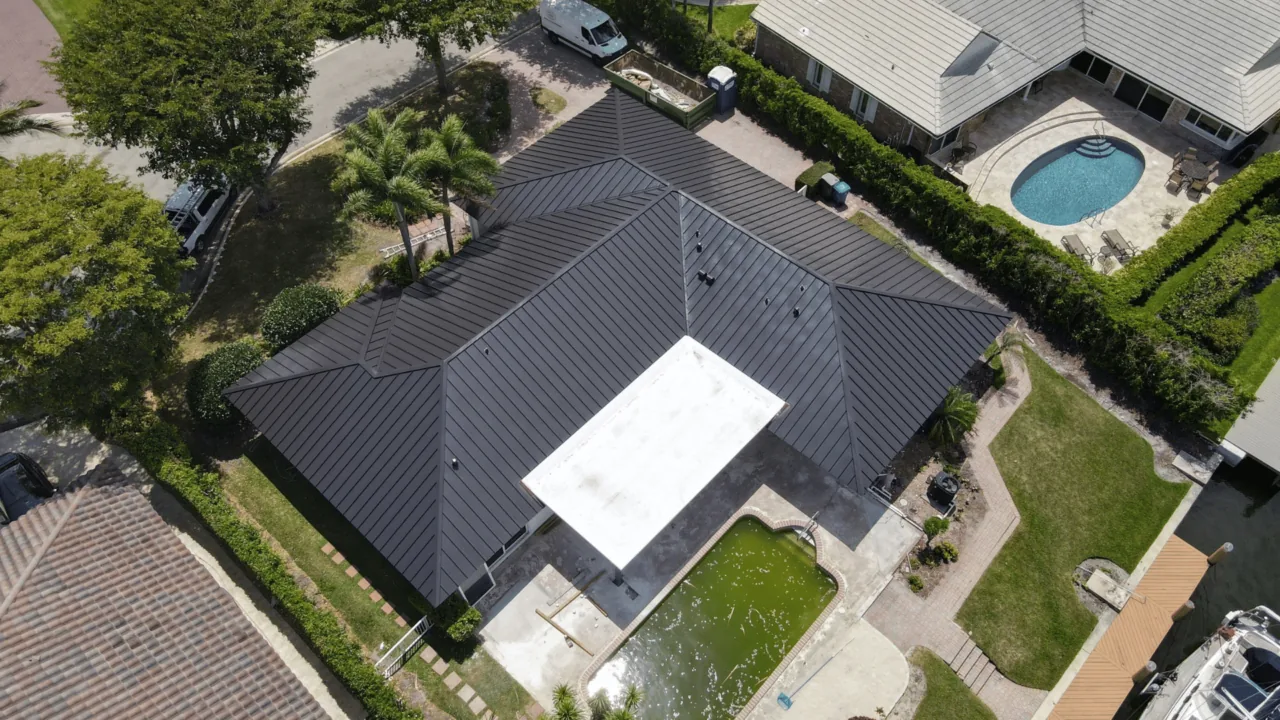
Watch out for the trucks that show up after a storm
Out-of-state crews follow every Florida hurricane. They collect deposits, do fast work, and are unreachable when the roof leaks in eight months.
We are Sebastian-based and Florida licensed under CCC1337211. Verify any contractor’s license number before you sign anything or hand over a deposit — including ours.
After a storm, in order
Stay off the roof
Assess from the ground. Storm-damaged decking gives way without warning.
Photograph everything
Document damage before any cleanup or temporary repair happens.
Stop the water
Emergency tarping first. The claim can be sorted out afterward.
Verify the license
Check the contractor’s Florida license before a deposit changes hands.
What a hurricane actually does to a roof
Understanding the mechanism tells you where to look — and why the damage that matters most is usually invisible from your driveway.
Uplift, not push
Hurricane wind does not mainly push down on a roof, it lifts it. Air accelerating over the roof plane creates negative pressure above the surface, and the highest suction occurs at corners, edges and ridges — not in the middle of the field. That is exactly why the Florida Building Code requires tighter fastener spacing at perimeters and corners, and why undersized edge metal is such a consequential defect.
Progressive failure
Roofs rarely fail all at once. One tab loses its seal, flutters, and levers its neighbour loose. That one lifts the next. A single compromised edge can unzip a large area over the course of a few hours. It is also why damage from one storm makes you far more vulnerable in the next one.
Driven rain goes sideways and uphill
At hurricane wind speeds water is pushed horizontally and forced underneath the covering against gravity. No shingle, tile or panel system is watertight against that on its own — which is the entire reason the secondary water barrier is mandatory on Florida reroofs. On a roof without one, losing surface material means water in the house.
Debris impact
Branches, fence panels, roof material from other buildings, and unsecured outdoor items. Punctures are obvious. The bruising left by something heavy rolling across a shingle field is not, and it shortens the roof life without leaking for years.
Pressurisation through openings
A broken window or a failed garage door on the windward side lets the storm pressurise the interior, and that internal pressure pushes up on the roof deck at the same moment the wind is pulling on it from above. This is how roofs come off whole. Opening protection is a roofing issue even though the openings are not on the roof.
Our wind numbers
Indian River County design wind speed is 160 mph east of I-95 and 150 mph west. We are not in the High-Velocity Hurricane Zone — that is Miami-Dade and Broward — but ASCE 7 requirements here are serious and they drive every fastening decision on your roof.
Damage you can see, and damage you cannot
The second list is the one that costs people their claim window.
Obvious: missing shingles or tile
Bare underlayment or bare deck showing. Unambiguous, and it needs tarping immediately.
Obvious: displaced ridge or edge metal
Ridge cap gone, drip edge peeled back, gable metal lifted. Often the first visible sign that uplift got underneath.
Obvious: debris impact
Punctures, cracked tile, dented metal panels, a branch still sitting on the roof.
Hidden: broken seal strips
The most common and most consequential. The shingle is still in place and looks perfect from the ground, but its adhesive bond is broken and it will leave in the next wind event.
Hidden: creased tabs
A shingle that lifted and laid back down carries a crease. That crease is a fracture in the mat and it will open. Adjusters look for these specifically.
Hidden: slipped tile and torn underlayment
Tile that shifted a fraction exposes the underlayment doing the actual waterproofing to UV. It will not leak this month. It will leak.
Before the storm: what actually helps
Most pre-season advice is generic. This is the part that is specific to a roof.
Get the roof inspected before June, not after
The single highest-value thing you can do. Loose or unsealed shingles, failed pipe boots and compromised flashing are cheap to fix in May and catastrophic in September. Our inspection is free.
Fix small things now
A cracked pipe boot, a lifted tab, a loose piece of edge metal. Each of those is a starting point for progressive failure under uplift. None of them is expensive right now.
Clear the trees
Overhanging limbs become projectiles and abrade the roof surface in sustained wind. Trim back anything within reach of the roof plane, and do it well before a storm is named — tree crews book solid the moment one is.
Clean the gutters and drains
A roof that cannot drain during 15 inches of rain in 12 hours backs water up under the covering. On low-slope sections a blocked drain is how you get standing water on a roof during the worst possible conditions.
Photograph your roof now, while it is intact
This is the trick almost nobody does. A dated set of photographs of your roof in good condition, taken before the season, is enormously powerful evidence if you later need to demonstrate that damage was storm-caused rather than pre-existing.
Know your deductible before you need to
Hurricane deductibles in Florida are usually a percentage of dwelling coverage, not a flat figure. On a $500,000 dwelling, 2% is $10,000. Find out now, not while your ceiling is dripping. See hurricane roof prep.
Hurricane roof damage FAQs
My roof looks fine after the storm. Should I still get it checked?
Yes. Broken seal strips and creased tabs are the most common forms of hurricane damage and neither is visible from the ground. They leak months later, by which point your one-year filing window under Florida Statute 627.70132 may be closing. See our Florida roof insurance claim guide for the full filing process.
How long do I have to file a hurricane claim in Florida?
One year from the date of loss for an initial claim and 18 months for a supplemental. Both clocks start on the storm date, not the date you discovered the damage.
What is my hurricane deductible?
Usually a percentage of your dwelling coverage rather than a flat dollar amount - commonly 2% or 5%. On a $500,000 dwelling a 2% hurricane deductible is $10,000 before the carrier pays anything. Check your declarations page; it is a different and much larger figure than your all-other-perils deductible.
Is Sebastian in the High-Velocity Hurricane Zone?
No. The HVHZ is Miami-Dade and Broward counties only. Indian River County builds to the Florida Building Code and ASCE 7 at a 160 mph ultimate design wind speed east of I-95 and 150 mph west. A contractor quoting HVHZ-specific products here is adding cost without adding compliance.
Will a metal roof survive a hurricane better?
Properly installed standing seam metal has excellent uplift performance and no exposed fasteners to work loose, so yes, generally. But installation quality matters more than material - a well-installed high-wind shingle roof outperforms a badly installed metal one every time. See metal roofing.
Someone knocked on my door offering a free roof inspection. Should I let them?
Be careful. Legitimate contractors are licensed in Florida with a verifiable CCC or CGC number, do not need a signature today, and never offer to cover your deductible - that is insurance fraud and it is the homeowner who is exposed. See hurricane roofing scams.
What is the 25% rule and does it apply to me?
If more than 25% of a roof section is repaired or replaced within 12 months, that section may have to be brought to current code. Since May 2022 there is a major exception: if the existing system was built to the 2007 Florida Building Code or later, only the damaged portion has to comply. See the 25% rule.
How soon can you respond after a hurricane?
Active leaks get priority and we tarp first. After a major named storm the whole region calls in the same 48 hours, so call early - the queue only grows. See emergency roof tarping.
Should I wait for the adjuster before calling a roofer?
No. Stop the water immediately - mitigation is your obligation under the policy. Then get an independent assessment before the adjuster arrives, so you know what is actually wrong with your roof rather than learning it from someone whose employer pays the claim. We are happy to meet your adjuster on site.
Can you help with the insurance claim?
We document the roof to carrier standards with dated photographs, measurements and a code-compliant written scope, and we meet your adjuster. We are not public adjusters and we do not negotiate your claim or take an assignment of benefits. For complex claims a licensed public adjuster is a legitimate option.
Proudly serving the Treasure Coast
Let's take a look at your roof. Free.
No pressure, no obligation, and an honest answer even when that answer is "you don't need a new roof yet."
- Free, itemized estimate in writing
- Most inspections scheduled within 24 hours
- We handle permits and insurance paperwork
- Licensed CCC1337211 and fully insured
Request your free estimate
Four quick fields. That's all we need.