
Commercial Roofing in Vero Beach, FL
Leeward Roofing installs, repairs, and maintains flat and low-slope commercial roofs for Vero Beach businesses — built for Indian River County's salt air, sun, and storm season.
Commercial Roofing Systems We Install
TPO single-ply
Reflective, energy-efficient membrane that cuts cooling costs in the Vero sun.
Modified bitumen & BUR
Tough, multi-layer systems for high-traffic and older low-slope roofs.
Metal & standing seam
Long-life, high-wind-rated panels for commercial and mixed-use buildings.
Silicone & coatings
Restore and extend a sound flat roof while lowering energy bills.
Vero Beach Businesses We Serve
We work with retail centers, offices, restaurants, medical and professional buildings, warehouses, churches, and HOA and condo communities throughout Vero Beach, Indian River Shores, and the barrier island. Whether you manage one storefront or a portfolio of buildings, we keep your roofs leak-free and your downtime minimal.
What Commercial Roofing Costs in Vero Beach
$7–$14+ per square foot installed
Commercial TPO and modified-bitumen systems are priced by membrane thickness, insulation, deck condition, roof access, and whether you re-cover or tear off. We inspect first and give your ownership group or property manager a scoped proposal they can budget against — no lowball that grows mid-job.
Get a Free Commercial Roof Estimate in Vero Beach
Call Leeward Roofing at 772-589-2400 or contact us online. We'll inspect your roof, answer your questions, and give you a clear, honest quote.
Vero Beach Commercial Roofing FAQs
Can you re-roof without disrupting the business?
Usually yes. We schedule around your hours and, where the existing roof qualifies, a recover can cut time and cost.
Which commercial roofing system is best?
TPO is a popular choice for its reflectivity and watertight heat-welded seams, but the right system depends on your building, budget, and roof condition.
Do you offer a maintenance program?
Yes — regular inspections and minor repairs prevent small issues from becoming expensive failures.
Storm damage in Indian River County? Don't wait for the second rain.
Indian River County sits on the open Atlantic with the lagoon behind it, so wind gets at a roof from both sides. The water that comes in during the first storm is what turns a repair into a renovation. We are based in Sebastian, which means our tarping crews are already inside the county when the call comes.
- Stay off the roof. Assess from the ground and from inside the attic.
- Photograph everything — wide shots and close-ups — before any cleanup.
- Call for emergency tarping to stop water getting further in.
- Verify any contractor's Florida licence before you sign anything.
Recent Leeward jobs
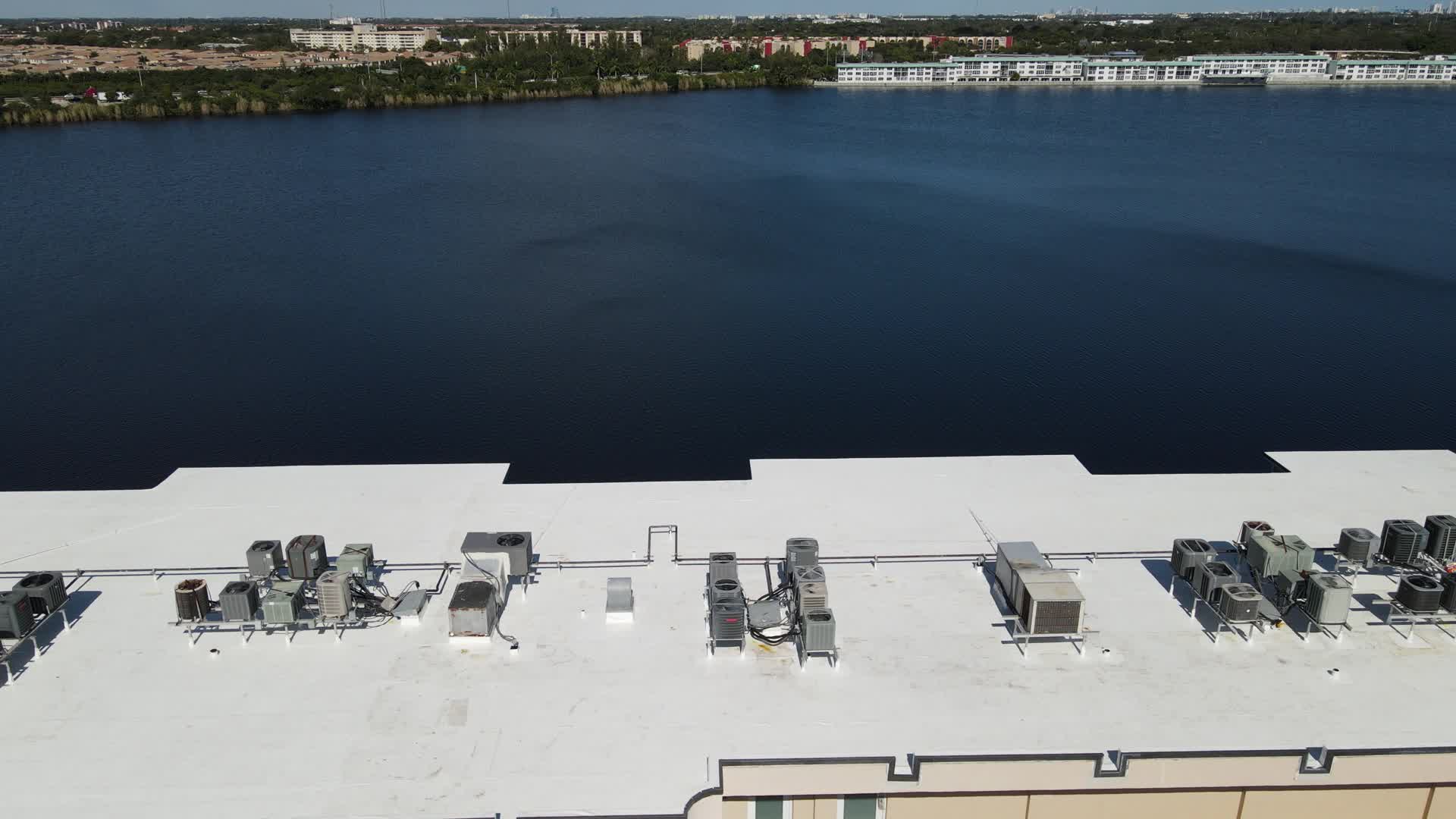
Real Treasure Coast roofs installed by our own crews — not stock photography.


Permitting and code in Vero Beach
Who issues the permit
Work in Vero Beach is permitted through the Indian River County Building Division. The county division handles permitting for both the City of Vero Beach and the unincorporated county, so a Vero address goes to the same reviewers either way. We pull it, schedule the inspections, and meet the inspector — none of that lands on you.
What the code actually requires
Indian River County builds to the Florida Building Code, which adopts the ASCE 7-22 wind provisions. Worth knowing: the Treasure Coast is not in the High-Velocity Hurricane Zone — only Miami-Dade and Broward carry that designation — so HVHZ product assumptions imported from South Florida do not apply here. Commercial low-slope work adds fire-classification and uplift documentation to the submittal.
What we see on Vero Beach roofs
Vero Beach housing runs from 1950s downtown bungalows to barrier-island estates, so the right system varies street to street.
Wind mitigation, while we are up there
A re-roof is the cheapest moment you will ever get to earn wind mitigation credits, because the nailing pattern and secondary water barrier are going in anyway. We document it so your insurer can actually apply the discount. How wind mitigation credits work →
Commercial roofs fail in four places, not everywhere
Seams, terminations, penetrations and drainage. Everything else is detail.
Seams
Where two membrane sheets meet. TPO seams are hot-air welded into one continuous sheet, and a weld run too cool, too fast or over a dirty surface holds for two seasons then opens. We probe seams with a hook on every inspection because a weld either holds or it does not.
Terminations
Where the membrane stops — walls, parapets, curbs and edges. Termination bar, counterflashing and sealant have to be detailed properly and maintained. This is the most common failure we find on roofs installed by the lowest bidder.
Penetrations
Every pipe, conduit, drain, hatch and HVAC curb is a hole in a waterproof surface with a boot or flashing over it. On a commercial roof there can be dozens, and each one is a potential leak.
Drainage
Low-slope does not mean no slope. Blocked drains, undersized scuppers, crushed insulation and settled decking create ponding, and standing water finds every marginal detail and exploits it.
Mechanical damage
Foot traffic from HVAC service, dropped tools, stored equipment. Walkway pads where people actually walk cost very little and prevent a great deal.
Thermal cycling
Membranes expand and contract daily. Over years that movement works at every fastener, seam and termination — which is why low-slope needs periodic inspection in a way steep-slope does not.
The specification decisions that actually matter
Six numbers on the quote that separate a 25-year roof from a 12-year one. Ask about all six.
Membrane thickness
45, 60 or 80 mil. The jump from 45 to 60 is the best value decision on most commercial roofs, and it is where cheap bids quietly save money. Ask which you are being quoted.
Insulation R-value and thickness
Polyiso thickness drives energy performance and cost, and code sets a minimum. Tapered insulation to correct a drainage problem costs more and is frequently the thing that actually fixes your roof.
Attachment method
Mechanically attached is faster and cheaper; fully adhered performs better under uplift and is quieter. The right answer comes from the wind uplift calculation and your deck type, not from what installs fastest.
Cover board
A layer between insulation and membrane that resists punctures and improves fire and wind ratings. Routinely omitted from low bids, and routinely the reason one roof survives foot traffic and another does not.
Termination and flashing detail
Parapets, curbs, scuppers and edge metal. This is where low-slope roofs fail, so it is where the quote should be most specific — and usually is not.
Warranty type
A manufacturer material warranty is not the same as a full system NDL warranty covering material and labour. Know which you are getting, how long it runs and what voids it.
Keeping tenants trading while we work
On an Indian River County commercial building the roof is rarely the hard part — keeping tenants trading through it is.
Phased by section
We tear off only what we can dry in the same day. Nothing sits open overnight and no afternoon storm lands on an open deck above your tenant’s inventory.
Access agreed before day one
Crane or conveyor placement, dumpster siting, material staging, crew parking and fire lane clearance settled in advance rather than negotiated in the car park on the morning.
Rooftop equipment coordinated
HVAC units, condensers, exhaust fans and ductwork lifted, flashed and reset with your mechanical contractor. Every curb gets new flashing — reusing old flashing under a new membrane is how a brand new roof leaks in year two.
Written schedule to circulate
So your tenants hear about the noise from you, in advance, rather than from the noise.
Out-of-hours where scope allows
For restaurants, medical suites and retail we will work around trading hours. It costs more on the invoice and is frequently cheaper than the lost revenue.
An asset file at the end
Photo set, product approvals, warranty documentation and permit close-out, packaged so your property manager can file it and your next roofer can read it.
Vero Beach commercial roofing FAQs
How long does a commercial flat roof last?
A properly specified and installed TPO system typically gives 20 to 25 years in Indian River County; modified bitumen similar. Membrane thickness, weld quality and drainage move that number far more than the manufacturer does.
What thickness should I specify?
60 mil is the sensible default for most commercial buildings here. 80 mil is worth it where there is heavy foot traffic or significant rooftop equipment. 45 mil is where cheap bids find their savings.
Can I recover over the existing roof instead of tearing off?
Florida permits a single recover where the existing system is dry and structurally sound. We core-sample to verify rather than assume. If the insulation is saturated or there has already been a recover, it has to come off.
Why is water standing on my roof?
Inadequate original drainage, blocked drains or scuppers, or settled insulation and deck creating low spots. Water persisting more than 48 hours after rain finds every marginal detail and voids many manufacturer warranties.
Will the work disrupt my tenants?
There is noise and crane activity, but the roof stays weathertight throughout because we dry in everything we open the same day. We phase the work and can work outside trading hours where scope allows.
Who handles the rooftop HVAC units?
We coordinate lifting, flashing and resetting with your mechanical contractor. Every curb gets new flashing - reusing old flashing under a new membrane is how a brand new roof leaks in year two.
What is the difference between a material warranty and an NDL warranty?
A material warranty covers the membrane if the product is defective. A no-dollar-limit system warranty covers material and labour for the full assembly, is issued by the manufacturer after their own inspection, and requires a certified installer.
Who issues the permit in Vero Beach?
Indian River County and the City of Vero Beach share a single joint Building Division on one application form, so city and unincorporated addresses go to the same reviewers. That is simpler than St. Lucie or Martin County. The Building Division is on 772-226-1260.
What is the design wind speed?
160 mph ultimate design wind speed east of I-95 and 150 mph west. Nearly every Vero Beach address is in the 160 band. On a low-slope commercial roof that drives the uplift calculation and therefore attachment method and fastening density.
Do you offer maintenance agreements?
Yes, and on a low-slope roof it is the highest-return maintenance money available. Scheduled seam and termination checks, drain clearing and minor repairs caught early.
Do you work on barrier island commercial buildings?
Yes. Ocean exposure puts them in Exposure D under FBC R301.2.1.4.3, which raises corner and perimeter uplift pressures significantly and means corrosion-resistant metal throughout - edge metal, termination bar, fasteners and counterflashing.
Do you handle condo and HOA association roofs?
Regularly. Work is phased so residents stay put, with a written schedule you can circulate to owners, itemised scopes suitable for board approval and a documented close-out package for the association’s asset file.
We also work near Vero Beach
Same crews, same trucks — these are the communities immediately around Vero Beach that we cover from the Sebastian shop.
Let's take a look at your roof. Free.
No pressure, no obligation, and an honest answer even when that answer is "you don't need a new roof yet."
- Free, itemized estimate in writing
- Most inspections scheduled within 24 hours
- We handle permits and insurance paperwork
- Licensed CCC1337211 and fully insured
Request your free estimate
Four quick fields. That's all we need.